Science. 1972 May 5;176(4034):512-4.
Toxic substances in plants and the food habits of early man.
Leopold AC, Ardrey R.
The widespread occurrence of toxic substances in plants must have greatly restricted their usefulness as food for primitive man. The development of cooking of plant products is suggested to have been a major evolutionary advance, making a major increase in the vegetable materials palatable to man; this technical advantage apparently occurred only in the most recent 2 percent of the anthropological record.
Toxic substances in plants and the food habits of early man
Posted in General.
Comments Off on Toxic substances in plants and the food habits of early man
– June 22, 2012
Fermentable Carbohydrates, Anxiety, Aggression
Also see:
Ray Peat, PhD on the Benefits of the Raw Carrot
Estrogen, Serotonin, and Aggression
Endotoxin: Poisoning from the Inside Out
Scanning Electron Microscope (SEM) images of plant cell microparticles in urine sediment
THE PHENOMENON OF PERSORPTION: PERSORPTION, DISSEMINATION, AND ELIMINATION OF MICROPARTICLES
“The food industry is promoting the use of various gums and starches, which are convenient thickeners and stabilizers for increasing self-life, with the argument that the butyric acid produced when they are fermented by intestinal bacteria is protective. However, intestinal fermentation increases systemic and brain serotonin, and the short-chain fatty acids can produce a variety of inflammatory and cytotoxic effect. Considering the longevity and stress-resistance of germ-free animals, choosing foods (such as raw carrots or cooked bamboo shoots or cooked mushrooms) which accelerate peristalsis and speed transit through the bowel, which suppressing bacterial growth, seems like a convenient approach to increasing longevity.” -Ray Peat, PhD
Physiol Behav. 2004 Sep 15;82(2-3):357-68.
Anxiety and aggression associated with the fermentation of carbohydrates in the hindgut of rats.
Hanstock TL, Clayton EH, Li KM, Mallet PE.
Lactic acid accumulation in the caecum and colon resulting from the fermentation of carbohydrates can lead to deleterious effects in ruminant and monogastric animals, including humans. In the present study, we examined the behavioural effects of two types of commonly consumed foods: soluble and fermentable carbohydrates (FCs). Thirty-six male Wistar rats were fed either a commercial rat and mouse chow, a soluble carbohydrate (SC)-based diet or an FC-based diet. Social interaction, anxiety, aggression and locomotor activity were examined by employing a social interaction test and a light/dark emergence test, while physical parameters of hindgut fermentation were examined after sacrifice, either 3 or 21 h after feeding. Results showed that anxiety (spending less time in the light compartment during the light/dark emergence test) and aggression (increased fighting during the social interaction test) were increased following raised concentrations of fermentation end products, such as lactic acid and volatile fatty acids (VFAs) in the caecum of rats. These associations occurred regardless of dopamine and 5-HT concentrations in the prefrontal cortex (PFC) and provide evidence supporting a general effect of FCs on behaviour. Possible mechanisms of action along with similarities between a rat and human model of acidosis are discussed.
Asia Pac J Clin Nutr. 2003;12 Suppl:S12.
Anxiety following increased hind-gut fermentation.
Hanstock TL, Claytons EH, Mallet PE.
Background – Previous investigations into the effects of carbohydrate on behaviour have focussed on behavioural changes 2-4 hrs after consumption of the diet and have not considered the effect of site of digestion. Fermentation and lactic acid production in the caecum and colon can lead to detrimental effects in several animal models, including adverse behaviour in horses. Objective – To determine changes in anxiety promoted by the consumption of fermentable carbohydrate and increased fermentation in the hind-gut of rats. Design – Randomised control trial with 3 iso-energetic dietary treatment groups, a soluble carbohydrate diet containing wheat (n=12), a fermentable carbohydrate diet based on cooked and cooled rice (n=12) and a basal control rat and mouse Chow diet (n= 12). Behaviour was assessed 3 and 21 hrs after dietary consumption by the light dark emergence test. Outcomes – The 3 diets promoted different fermentation patterns in terms of pH and lactic acid concentrations in the caecum of rats 3 or 21 hrs after consumption. The length of time spent in the dark compartment of the light dark emergence test, indicating increased anxiety, was associated with increased concentrations of D- and L-lactic acid in the caecum (r(2)= 0.97 and 0.96 respectively; P <0.01) irrespective of dietary group. Conclusions – Fermentation of carbohydrate leading to increased concentrations of lactic acid in the caecum of rats was associated with increased anxiety in rats. This has important implications in terms of those diets promoting increased fermentation (eg. with a high intake of resistant starch) without considering any possible detrimental effects.
===================================
Fermentable fibers raise ammonia.
J Nutr. 1989 Feb;119(2):235-41.
Independent effects of fiber and protein on colonic luminal ammonia concentration.
Lupton JR, Marchant LJ.
The potential interactive effects of protein and fiber on cecal and colonic surface areas, colonic luminal ammonia concentrations, luminal pH and blood indices of nitrogen metabolism were tested using two levels of protein (8% and 24%) and two types of fiber (8% pectin or cellulose). Pectin supplementation resulted in larger cecal surface areas and longer large intestines than those of rats fed fiber-free or cellulose-supplemented diets. All high protein diets resulted in total large bowel luminal ammonia (NH3 + NH4+) concentrations that were twice as high as their low protein counterparts (P less than 0.05). The effect of fiber on ammonia concentration depended on the fiber type. In the distal colon, pectin-fed animals had three times the ammonia concentration of the fiber-free animals, and 4-5 times the ammonia concentration of the cellulose-fed animals (P less than 0.001). Blood urea nitrogen values were higher in the high protein than in the low protein groups (P less than 0.05), and highest in the high protein/pectin animals (P less than 0.01). This study clearly demonstrates that luminal ammonia concentration is dependent upon both protein level and fiber type, and that a fermentable fiber (pectin), rather than decreasing colonic ammonia concentrations, actually increases them several-fold.
===================================
Dietary fats protect against anxiety from bacterial fermentation.
Physiol Behav. 1996 Sep;60(3):1039-42.
Short-term consumption of a diet rich in fat decreases anxiety response in adult male rats.
Prasad A, Prasad C.
Short- and long-term changes in the composition of dietary macronutrients [protein (P), carbohydrate (C), and fat (F)] alter neurochemistry and behavior in animals. We examined whether short-term intake of a diet rich in P, C, or F affected their anxiety response (AR). AR of Sprague-Dawley rats was measured in an elevated plus maze. Rats were placed in the black compartment facing the wall opposite the aperture, and the time (max. 360 s) it took to enter the white compartment with all four paws was noted. Rats were fed Purina chow and tap water unless otherwise indicated. On repeated testing (three times on the same day) AR increased and, consequently, most rats spent the entire 360 s in the dark. Whereas most rats exhibited low anxiety response in trial 1, which increased during successive trials (low-high group), some exhibited high initial anxiety that remained unchanged (high-high group). To determine whether macronutrients may alter AR, groups of low-high and high-high rats were tested three times on the same day and then put on a P, C, or F diet for 7 days. On day 8, they were again tested for AR in a single trial and the results compared with those of the third trial of the previous test (preC: 302 +/- 39, post-C: 294 +/- 42, p > 0.05; pre-P: 305 +/- 35, post-P: 297 +/- 43, p > 0.05; pre-F: 321 +/- 17, post-F: 241 +/- 24sec, p = 0.009; n = 30; mean +/- SEM). The results show that a diet rich in F, but not P or C, decreases AR in rats.
Posted in General.
Comments Off on Fermentable Carbohydrates, Anxiety, Aggression
– June 22, 2012
Growth Hormone and Edema
Also see:
W.D. Denckla, A.V. Everitt, Hypophysectomy, & Aging
Removal of the Pituitary: Slows Aging and Hardening of Collagen
“Normal” TSH: Marker for Increased Risk of Fatal Coronary Heart Disease
Inflammatory TSH
“Growth hormone clearly causes edema, and this is probably involved in the pathological processes that it can produce.”-Ray Peat, PhD

J Clin Endocrinol Metab. 1991 Apr;72(4):768-72.
Expansion of extracellular volume and suppression of atrial natriuretic peptide after growth hormone administration in normal man.
Møller J, Jørgensen JO, Møller N, Hansen KW, Pedersen EB, Christiansen JS.
Sodium retention and symptoms and signs of fluid retention are commonly recorded during GH administration in both GH-deficient patients and normal subjects. Most reports have however, been casuistic or uncontrolled. In a randomized double blind placebo-controlled cross-over study we therefore examined the effect of 14-day GH administration (12 IU sc at 2000 h) on plasma volume, extracellular volume (ECV), atrial natriuretic peptide (ANP), arginine vasopressin, and the renin angiotensin system in eight healthy adult men. A significant GH induced increase in serum insulin growth factor I was observed. GH caused a significant increase in ECV (L): 20.45 +/- 0.45 (GH), 19.53 +/- 0.48 (placebo) (P less than 0.01), whereas plasma volume (L) remained unchanged 3.92 +/- 0.16 (GH), 4.02 +/- 0.13 (placebo). A significant decrease in plasma ANP (pmol/L) after GH administration was observed: 2.28 +/- 0.54 (GH), 3.16 +/- 0.53 (placebo) P less than 0.01. Plasma aldosterone (pmol/L): 129 +/- 14 (GH), 89 +/- 17 (placebo), P = 0.08, and plasma angiotensin II (pmol/L) levels: 18 +/- 12 (GH), 14 +/- 7 (placebo), P = 0.21, were not significantly elevated. No changes in plasma arginine vasopressin occurred (1.86 +/- 0.05 pmol/L vs. 1.90 +/- 0.05, P = 0.33). Serum sodium and blood pressure remained unaffected. Moderate complaints, which could be ascribed to water retention, were recorded in four subjects [periorbital edema (n = 3), acral paraesthesia (n = 2) and light articular pain (n = 1)]. The symptoms were most pronounced after 2-3 days of treatment and diminished at the end of the period. In summary, 14 days of high dose GH administration caused a significant increase in ECV and a significant suppression of ANP.
Circulation. 1991 Jun;83(6):1880-7.
Pathogenesis of edema in constrictive pericarditis. Studies of body water and sodium, renal function, hemodynamics, and plasma hormones before and after pericardiectomy.
Anand IS, Ferrari R, Kalra GS, Wahi PL, Poole-Wilson PA, Harris PC.
BACKGROUND:
The pathogenesis of sodium and water accumulation in chronic constrictive pericarditis is not well understood and may differ from that in patients with chronic congestive heart failure due to myocardial disease. This study was undertaken to investigate some of the mechanisms.
METHODS AND RESULTS:
Using standard techniques, the hemodynamics, water and electrolyte spaces, renal function, and plasma concentrations of hormones were measured in 16 patients with untreated constrictive pericarditis and were measured again in eight patients after pericardiectomy. The average hemodynamic measurements were as follows: cardiac output, 1.98 l/min/m2; right atrial pressure, 22.9 mm Hg; pulmonary wedge pressure, 24.2 mm Hg; and mean pulmonary artery pressure 30.2 mm Hg. The systemic and pulmonary vascular resistances (36.3 +/- 2.5 and 3.2 +/- 0.3 mm Hg.min.m2/l, respectively) were increased. Significant increases occurred in total body water (36%), extracellular volume (81%), plasma volume (53%), and exchangeable sodium (63%). The renal plasma flow was only moderately decreased (49%), and the glomerular filtration rate was normal. Significant increases also occurred in plasma concentrations of norepinephrine (3.6 times normal), renin activity (7.2 time normal), aldosterone (3.4 times normal), cortisol (1.4 times normal), growth hormone (21.8 times normal), and atrial natriuretic peptide (5 times normal). The ratio of left atrial to aortic diameter measured by echocardiography was only minimally increased (1.29 +/- 0.04), indicating that in constrictive pericarditis the atria are prevented from expanding. The studies repeated after pericardiectomy in the eight patients showed that all measurements returned toward normal.
CONCLUSIONS:
The restricted distensibility of the atria, in constrictive pericarditis, limits the secretion of atrial natriuretic factor and, thus, reduces its natriuretic and diuretic effects. This results in retention of water and sodium greater than that occurring in patients with edema from myocardial disease. The arterial pressure is maintained more by the expansion of the blood volume than by an increase in the peripheral vascular resistance.
Circulation. 1989 Aug;80(2):299-305.
Edema of cardiac origin. Studies of body water and sodium, renal function, hemodynamic indexes, and plasma hormones in untreated congestive cardiac failure.
Anand IS, Ferrari R, Kalra GS, Wahi PL, Poole-Wilson PA, Harris PC.
This study provides data on plasma hormone levels in patients with severe clinical congestive cardiac failure who had never received therapy and in whom the presence of an accumulation of excess water and sodium had been established. Eight patients were studied; two had ischemic cardiac disease, and six had dilated cardiomyopathy. Mean hemodynamic measurements at rest were as follows: cardiac index, 1.8 l/min/m2; pulmonary wedge pressure, 30 mm Hg; right atrial pressure, 15 mm Hg. Total body water content was 16% above control, extracellular liquid was 33% above control, plasma volume was 34% above control, total exchangeable sodium was 37% above control, renal plasma flow was 29% of control, and glomerular filtration rate was 65% of control. Plasma norepinephrine was consistently increased (on average 6.3 times control), whereas adrenaline was unaffected. Although plasma renin activity and aldosterone varied widely, they were on average above normal (renin 9.5 times control, aldosterone 6.4 times control). Plasma atrial natriuretic peptide (14.3 times control) and growth hormone (11.5 times control) were consistently increased. Cortisol was also increased on average (1.7 times control). Vasopressin was increased only in one patient.
J Pediatr Endocrinol. 1994 Apr-Jun;7(2):93-105.
Studies on the renal kinetics of growth hormone (GH) and on the GH receptor and related effects in animals.
Krogsgaard Thomsen M, Friis C, Sehested Hansen B, Johansen P, Eschen C, Nowak J, Poulsen K.
“Growth hormone (GH) is filtered through the kidney, and may exert effects on renal function when presented via the circulation. Investigations on kidney-related aspects of GH are increasing in number…Short term administration of GH to rats and humans elicited electrolyte and water retention that may cause edema in adults.”
J Endocrinol Invest. 1999;22(5 Suppl):106-9.
Growth hormone and body composition in athletes.
Frisch H.
The anabolic properties of growth hormone (GH) have been investigated extensively. The effects of GH on normal, hypertrophied and atrophied muscles have been studied previously in animal experiments that demonstrated an increase in muscle weight and size, but no comparable increase in performance or tension. In adults with GH deficiency, the changes in body composition can be corrected by GH treatment; lean body mass and strength increase within a few months. In children with GH deficiency, Turner’s syndrome or intrauterine growth retardation, an increase in muscle tissue is seen after treatment with GH. In acromegalics with long-standing GH hypersecretion, the muscle volume is increased, but muscle strength and performance are not improved. These observations gave rise to the interest shown by healthy subjects and athletes in using GH to increase their muscle mass and strength. The improvements in muscle strength obtained by resistance exercise training in healthy older men or young men were not enhanced by additional administration of GH. The larger increases in fat-free mass observed in the GH-treated groups were obviously not due to accretion of contractile protein, but rather to fluid retention or accumulation of connective tissue. In experienced weightlifters, the incorporation of amino acids into skeletal muscle protein was not increased and the rate of whole body protein breakdown was not decreased by short-term administration of GH. The results of a study in power athletes confirm the results of these investigations. The study used GH treatment in power athletes compared with a placebo-control group, and the results indicated no increase in maximal strength during concentric contraction of the biceps and quadriceps muscles, although levels of insulin-like growth factor-I were doubled. In highly trained power athletes with low fat mass and high lean body mass, no additional effect of GH treatment on strength is to be expected.
Trends Endocrinol Metab. 2011 May;22(5):171-8. doi: 10.1016/j.tem.2011.02.005. Epub 2011 Mar 17.
Growth hormone and physical performance.
Birzniece V, Nelson AE, Ho KK.
There has been limited research and evidence that GH enhances physical performance in healthy adults or in trained athletes. Even so, human growth hormone (GH) is widely abused by athletes. In healthy adults, GH increases lean body mass, although it is possible that fluid retention contributes to this effect. The most recent data indicate that GH does not enhance muscle strength, power, or aerobic exercise capacity, but improves anaerobic exercise capacity. In fact, there are adverse effects of long-term GH excess such that sustained abuse of GH can lead to a state mimicking acromegaly, a condition with increased morbidity and mortality. This review will examine GH effects on body composition and physical performance in health and disease.
Endocrinol Metab Clin North Am. 2010 Mar;39(1):11-23, vii. doi: 10.1016/j.ecl.2009.10.007.
Growth hormone administration: is it safe and effective for athletic performance.
Birzniece V, Nelson AE, Ho KK.
Human growth hormone (GH) is widely abused by athletes; however, there is little evidence that GH improves physical performance. Replacement of GH in GH deficiency improves some aspects of exercise capacity. There is evidence for a protein anabolic effect of GH in healthy adults and for increased lean body mass following GH, although fluid retention likely contributes to this increase. The evidence suggests that muscle strength, power, and aerobic exercise capacity are not enhanced by GH administration, however GH may improve anaerobic exercise capacity. There are risks of adverse effects of long-term abuse of GH. Sustained abuse of GH may lead to a state mimicking acromegaly, a condition with increased morbidity and mortality.
Posted in General.
Comments Off on Growth Hormone and Edema
– June 22, 2012
Growth Hormone Unncessary for Normal Height
Intern Med. 1998 May;37(5):472-5.
A hypopituitary patient who attained tall stature without growth hormone.
Kageyama K, Watanobe H, Nasushita R, Nishie M, Horiba N, Suda T.
We describe an unusual patient with hypopituitarism who attained tall stature even without growth hormone (GH). A 37-year-old man was devoid of secondary sexual characteristics, but manifested tall stature with a eunuchoidal feature. Serum levels of GH, insulin-like growth factor-I, gonadotropins and testosterone were all below normal. GH secretion was not enhanced by any provocative stimulus. Adrenocorticotropic hormone increased after administration of corticotropin releasing hormone, but not after insulin-induced hypoglycemia. Thyrotropin increased in response to thyrotropin releasing hormone, but both free T3 and T4 did not rise. Magnetic resonance imaging disclosed a transected pituitary stalk. The present patient had hypopituitarism due to perinatal problems but had grown with the aid of non-GH growth-promoting factors, which suggests that man may be able to achieve statural growth even without GH.
Posted in General.
Comments Off on Growth Hormone Unncessary for Normal Height
– June 22, 2012
Hormonal profiles in women with breast cancer
Also see:
PUFA Increases Estrogen
Radiation Increases Breast Cancer Incidence
PUFA Inhibit Glucuronidation
PUFA Promote Cancer
Maternal PUFA Intake Increases Breast Cancer Risk in Female Offspring
Estrogen and Bowel Transit Time
Progestin and Cancer
Study: Acquired Breast Cancer Risk Spans Multiple Generations
Ray Peat, PhD on Thyroid, Temperature, Pulse, and TSH
Pre and Postmenopausal Women: Progesterone Decreases Aromatase Activity
Endometriosis and Estrogen
Progestin and Cancer
Ray Peat, PhD on the Menstrual Cycle
Lab study: Daily aspirin could block growth of breast, other cancers
Breast Cancers Can Produce Their Own Estrogen to Resist Aromatase Inhibitors
Quotes by Ray Peat, PhD:
“When the estrogen dominance persists for a long time without interruption, there are progressive distortions in the structure of the responsive organs–the uterus, breast, pituitary, lung, liver, kidney, brain, and other organs–and those structural distortions tend to progress gradually from fibroses to cancer.
As a result of the early studies in both humans and animals, progesterone was used by many physicians to treat the types of cancer that were clearly caused by estrogen, especially uterine, breast, and kidney cancers.”
“If the cancer-productive field is taken into account, all of the factors that promote and sustain that field should be considered during therapy.
Two ubiquitous carcinogenic factors that can be manipulated without toxins are the polyunsaturated fatty acids (PUFA) and estrogen. These closely interact with each other, and there are many ways in which they can be modulated.
For example, keeping cells in a well oxygenated state with thyroid hormone and carbon dioxide will shift the balance from estradiol toward the weaker estrone. The thyroid stimulation will cause the liver to excrete estrogen more quickly, and will help to prevent the formation of aromatase in the tissues. Low temperature is one of the factors that increases the formation of estrogen. Lactic acid, serotonin, nitric oxide, prostaglandins, and the endorphins will be decreased by the shift toward efficient oxidative metabolism.
Progesterone synthesis will be increased by the higher metabolic rate, and will tend to keep the temperature higher.
Thyroid hormone, by causing a shift away from estrogen and serotonin, lowers prolactin, which is involved in the promotion of several kinds of cancer.
Vitamin D and vitamin K have some antiestrogenic effects. Vitamin D and calcium lower the inflammation-promoting parathyroid hormone (PTH).
Eliminating polyunsaturated fats from the diet is essential if the bystander effect is eventually to be restrained. Aspirin and salicylic acid can block many of the carcinogenic effects of the PUFA. Saturated fats have a variety of antiinflammatory and anticancer actions. Some of those effects are direct, others are the result of blocking the toxic effects of the PUFA. Keeping the stored unsaturated fats from circulating in the blood is helpful, since it takes years to eliminate them from the tissues after the diet has changed. Niacinamide inhibits lipolysis. Avoiding over-production of lipolytic adrenaline requires adequate thyroid hormone, and the adjustment of the diet to minimize fluctuations of blood sugar.”
“The radical mastectomy, which removed massive amounts of apparently normal tissue as well as the breast tumor, was practiced for hundreds of years, and was the standard treatment for breast cancer until the 1980s, after G.W. Crile, Jr., had publicized the evidence showing that simply removing the tumor lump itself didn’t cause a higher mortality rate, and that the surgery produced much less disability.
Although the lumpectomy was eventually accepted by the profession, the evidence that the long term survival rate was higher when the surgery was done during the luteal phase in premenopausal women has been generally ignored, because the cancer ideology maintains that the fate of the cancer is in the cells, rather than in the patient’s hormone balance.”
“In the 1960s I read some articles in a small town newspaper about Leonell Strong’s cancer research, and his treatment by the American Cancer Society and the Salk Institute. Leonell Strong had developed strains of mice for use in cancer research. In some of the strains, 100% of the females developed mammary cancer. Strong had demonstrated that these strains had very high levels of estrogen.”
“Over the decades, many studies have confirmed that prolonged, continuous exposure to estrogen is carcinogenic, and that progesterone offsets those effects.
Following the animal studies that showed that carcinogenesis by estrogen could be prevented or reversed by progesterone, studies of the endogenous hormones in women showed that those with a natural excess of estrogen, and/or deficiency of progesterone, were the most likely to develop uterine or breast cancers.”
“A 1994 publication (B. Zumoff, “Hormonal profiles in women with breast cancer,” Obstet. Gynecol. Clin. North. Am. (U.S.) 21(4), 751-772) reported that there are four hormonal features in women with breast cancer: diminished androgen production, luteal inadequacy, increased 16-hydroxylation of estradiol, and increased prolactin. The 16-hydroxylation converts estradiol into estriol.”
“Two background facts are needed to interpret the JAMA article. The first is that hypothyroidism is a major cause of breast cancer, because of the chronic excess of estrogen and deficiency of progesterone. The second is that US doctors don’t correct hypothyroidism, because they don’t prescribe the active hormone T3, only the precursor T4, which fails to be converted because hypothyroid women’s livers aren’t efficient. T3 is needed for the storage of glycogen and the efficient use of glucose, and glucose is needed to form T3. Therefore, women in the US who “are treated for hypothyroidism” are still hypothyroid, and hypothyroid women are much more likely to get cancer.”
Obstet Gynecol Clin North Am. 1994 Dec;21(4):751-72.
Hormonal profiles in women with breast cancer.
Zumoff B.
The literature findings on endogenous hormonal profiles in women with breast cancer are reviewed in detail. It is concluded that four sets of findings are valid: (1) diminished adrenal androgen production, probably genetic, in women with premenopausal breast cancer; (2) ovarian dysfunction (luteal inadequacy plus increased testosterone production) in breast cancer at all ages; (3) increased 16 alpha-hydroxylation of estradiol in breast cancer at all ages; and (4) evidence that prolactin is a permissive risk factor for breast cancer, and that the pregnancy-induced decrease in prolactin levels may account for the protective effect of early pregnancy against breast cancer.
J Natl Cancer Inst. 1986 Sep;77(3):613-6.
Endogenous sex hormones, prolactin, and breast cancer in premenopausal women.
Meyer F, Brown JB, Morrison AS, MacMahon B.
Forty-one women with breast cancer and 119 controls participated in a case-control study of the relation of endogenous sex hormones to breast carcinoma in premenopausal women. During the follicular phase of the menstrual cycle, one overnight urine specimen was collected. During the luteal phase, urine and blood specimens were obtained. 17 beta-Estradiol, sex hormone-binding globulin, progesterone, and prolactin were measured in plasma, whereas estrogen metabolites (estrone, estradiol, and estriol) and pregnanediol were assessed in the urine. Breast cancer was associated with high-plasma estradiol and prolactin and with low progesterone. Similar but weaker associations were observed for urinary estrogens and pregnanediol in the luteal phase.
J Mammary Gland Biol Neoplasia. 1998 Jan;3(1):49-61.
Role of hormones in mammary cancer initiation and progression.
Russo IH, Russo J.
Breast cancer, the most frequent spontaneous malignancy diagnosed in women in the Western world, is a classical model of hormone dependent malignancy. There is substantial evidence that breast cancer risk is associated with prolonged exposure to female hormones, since early onset of menarche, late menopause, hormone replacement therapy and postmenopausal obesity are associated with greater cancer incidence. Among these hormonal influences a leading role is attributed to estrogens, either of ovarian or extra-ovarian origin, as supported by the observations that breast cancer does not develop in the absence of ovaries, ovariectomy causes regression of established malignancies, and in experimental animal models estrogens can induce mammary cancer. Estrogens induce in rodents a low incidence of mammary tumors after a long latency period, and only in the presence of an intact pituitary axis, with induction of pituitary hyperplasia or adenomas and hyperprolactinemia. Chemicals, radiation, viruses and genomic alterations have all been demonstrated to have a greater tumorigenic potential in rodents. Chemical carcinogens are used to generate the most widely studied rat models; in these models hormones act as promoters or inhibitors of the neoplastic process. The incidence and type of tumors elicited, however, are strongly influenced by host factors. The tumorigenic response is maximal when the carcinogen is administered to young and virgin intact animals in which the mammary gland is undifferentiated and highly proliferating. The atrophic mammary gland of hormonally-deprived ovariectomized or hypophysectomized animals does not respond to the carcinogenic stimulus. Administration of carcinogen to pregnant, parous or hormonally treated virgin rats, on the other hand, fails to elicit a tumorigenic response, a phenomenon attributed to the higher degree of differentiation of the mammary gland induced by the hormonal stimulation of pregnancy. In women a majority of breast cancers that are initially hormone dependent are manifested during the postmenopausal period. Estradiol plays a crucial role in their development and evolution. However, it is still unclear whether estrogens are carcinogenic to the human breast. The apparent carcinogenicity of estrogens is attributed to receptor-mediated stimulation of cellular proliferation. Increased proliferation could result in turn in accumulation of genetic damage and stimulation of the synthesis of growth factors that act on the mammary epithelial cells via an autocrine or paracrine loop. Alternatively estrogens may induce cell proliferation through negative feedback by removing the effect of one or several inhibitory factors present in the serum. Multidisciplinary studies are required for the elucidation of the mechanisms responsible for the initiation of breast cancer. Understanding of such mechanisms is indispensable for developing a rational basis for its prevention and control.
Tumori. 2000 Jan-Feb;86(1):12-6.
Factors of risk for breast cancer influencing post-menopausal long-term hormone replacement therapy.
Chiechi LM, Secreto G.
The advantages of hormone replacement therapy (HRT) are well documented in contrasting the symptomatology of climacterium and in reducing morbidity and mortality associated with coronary heart disease and osteoporotic fractures of postmenopausal age. However, growing evidence points to increased breast cancer risk in HRT long-term users, and the adverse effect would, obviously, overwhelm any other benefit. At present, the risk/benefit ratio of HRT is an object of hot debate, and we feel it necessary and urgent to select women who can safely benefit from HRT and women whose risk of breast cancer can be perilously increased by the raised hormonal levels related to HRT. We have reviewed studies on the breast cancer risk in HRT users and data on the interaction between steroid hormones and breast cancer. Reasoning that the outcome of mammary cancer can be increased by hormonal overstimulation of the breast, we have focused on those factors of risk that could be further enhanced by the exogenous hormonal stimulus of HRT, so as to cause a further significant increase in the risk of breast cancer. We conclude that some biologic and clinical markers, namely android obesity, bone density, mammographic density, androgen and estrogen circulating levels, alcohol consumption, benign breast disease, and familiarity, should be carefully considered before prescribing long-term HRT. Our analysis suggests that HRT could increase the risk of breast cancer and useless in preventing coronary heart disease and osteoporotic fractures when administered in women with positivity for one or more of these markers.
Endocrinol Metab Clin North Am. 2011 Sep;40(3):473-84, vii. Epub 2011 Jun 29.
Estrogen carcinogenesis in breast cancer.
Germain D.
Many studies have reported a correlation between elevated estrogen blood levels and breast cancer and this observation has raised controversy concerning the long-term use of hormonal replacement therapy. This review will not address further this controversial topic; but rather, this review focuses on the role of estrogen signaling in first, the normal development of the breast and second, how alterations of this signaling pathway contribute to breast cancer.
Ann N Y Acad Sci. 1988;538:257-64.
Possible relevance of steroid availability and breast cancer.
Bruning PF, Bonfrer JM.
The as yet circumstantial evidence for a central role of estrogens in the promotion of human breast cancer is supported by many data. However, it has not been possible to identify breast cancer patients or women at risk by abnormally elevated estrogen levels in plasma. The concept of available, i.e., non-SHBG bound sex steroid seems to offer a better understanding than total serum steroid levels do. We demonstrated that sex steroid protein binding is decreased by free fatty acids. This finding may help to explain how the affluent Western diet and sedentary life style is related to high incidence rates of breast cancer. We have postulated that it is especially the central (abdominal) type of obesity which may increase sex steroid availability. This mechanism could be important already at the age of breast development when the sensitivity to promotion seems relatively great. It may also explain the increased incidence rates which are observed in Western industrialized countries after menopause. It seems likely that other endocrine-related cancer, such as endometrial or prostatic carcinomas are influenced in an analogous way.
Am J Epidemiol. 1981 Aug;114(2):209-17.
Breast cancer incidence in women with a history of progesterone deficiency.
Cowan LD, Gordis L, Tonascia JA, Jones GS.
In order to investigate the nature of the association of involuntarily delayed 1st birth and breast cancer risk, 1083 white women who had been evaluated and treated for in fertility from 1945-65 were followed prospectively through April 1978 to ascertain their breast cancer incidence. These women were categorized as to the cause of infertility into 2 groups, those with endogenous progesterone deficiency (PD) and those with nonhormonal causes (NH). Women in the PD group had 5.4 times the risk of premenopausal breast cancer as compared to women in the NH group. This excess risk could not be explained by differences between the 2 groups in age at menarche or age at menopause, history of oral contraceptive use, history of benign breast dieases, or age at 1st birth. Women in the PD group also experienced a 10-fold increase in deaths from all malignant neoplasm compared to the NH group. The incidence of postmenopausal breast cancer did not differ significantly between the 2 groups.
Cancer Res August 1, 2014 74; 4078
Recent Oral Contraceptive Use by Formulation and Breast Cancer Risk among Women 20 to 49 Years of Age
Elisabeth F. Beaber, Diana S.M. Buist, William E. Barlow, Kathleen E. Malone, Susan D. Reed, and Christopher I. Li
Previous studies of oral contraceptives and breast cancer indicate that recent use slightly increases risk, but most studies relied on self-reported use and did not examine contemporary oral contraceptive formulations. This nested case–control study was among female enrollees in a large U.S. integrated health care delivery system. Cases were 1,102 women ages 20 to 49 years diagnosed with invasive breast cancer from 1990 to 2009. Controls were randomly sampled from enrollment records (n = 21,952) and matched to cases on age, year, enrollment length, and medical chart availability. Detailed oral contraceptive use information was ascertained from electronic pharmacy records and analyzed using conditional logistic regression, ORs, and 95% confidence intervals (CI). Recent oral contraceptive use (within the prior year) was associated with an increased breast cancer risk (OR, 1.5; 95% CI, 1.3–1.9) relative to never or former OC use. The association was stronger for estrogen receptor–positive (ER+; OR, 1.7; 95% CI, 1.3–2.1) than estrogen receptor–negative (ER−) disease (OR, 1.2, 95% CI, 0.8–1.8), although not statistically significantly different (P = 0.15). Recent use of oral contraceptives involving high-dose estrogen (OR, 2.7; 95% CI, 1.1–6.2), ethynodiol diacetate (OR, 2.6; 95% CI, 1.4–4.7), or triphasic dosing with an average of 0.75 mg of norethindrone (OR, 3.1; 95% CI, 1.9–5.1; Pheterogeneity compared with using other oral contraceptives = 0.004) was associated with particularly elevated risks, whereas other types, including low-dose estrogen oral contraceptives, were not (OR, 1.0; 95% CI, 0.6–1.7). Our results suggest that recent use of contemporary oral contraceptives is associated with an increased breast cancer risk, which may vary by formulation. If confirmed, consideration of the breast cancer risk associated with different oral contraceptive types could impact discussions weighing recognized health benefits and potential risks. Cancer Res; 74(15); 4078–89. ©2014 AACR.
========================
Environment and breast cancer risk:
Environmental Health 2012, 11:87
Breast cancer risk in relation to occupations with exposure to carcinogens and endocrine disruptors: a Canadian case–control study
James T Brophy, Margaret M Keith, Andrew Watterson, Robert Park, Michael Gilbertson, Eleanor Maticka-Tyndale, Matthias Beck, Hakam Abu-Zahra, Kenneth Schneider, Abraham Reinhartz, Robert DeMatteo and Isaac Luginaah
Background
Endocrine disrupting chemicals and carcinogens, some of which may not yet have been classified as such, are present in many occupational environments and could increase breast cancer risk. Prior research has identified associations with breast cancer and work in agricultural and industrial settings. The purpose of this study was to further characterize possible links between breast cancer risk and occupation, particularly in farming and manufacturing, as well as to examine the impacts of early agricultural exposures, and exposure effects that are specific to the endocrine receptor status of tumours.
Methods
1006 breast cancer cases referred by a regional cancer center and 1146 randomly-selected community controls provided detailed data including occupational and reproductive histories. All reported jobs were industry- and occupation-coded for the construction of cumulative exposure metrics representing likely exposure to carcinogens and endocrine disruptors. In a frequency-matched case–control design, exposure effects were estimated using conditional logistic regression.
Results
Across all sectors, women in jobs with potentially high exposures to carcinogens and endocrine disruptors had elevated breast cancer risk (OR = 1.42; 95% CI, 1.18-1.73, for 10 years exposure duration). Specific sectors with elevated risk included: agriculture (OR = 1.36; 95% CI, 1.01-1.82); bars-gambling (OR = 2.28; 95% CI, 0.94-5.53); automotive plastics manufacturing (OR = 2.68; 95% CI, 1.47-4.88), food canning (OR = 2.35; 95% CI, 1.00-5.53), and metalworking (OR = 1.73; 95% CI, 1.02-2.92). Estrogen receptor status of tumors with elevated risk differed by occupational grouping. Premenopausal breast cancer risk was highest for automotive plastics (OR = 4.76; 95% CI, 1.58-14.4) and food canning (OR = 5.70; 95% CI, 1.03-31.5).
Conclusions
These observations support hypotheses linking breast cancer risk and exposures likely to include carcinogens and endocrine disruptors, and demonstrate the value of detailed work histories in environmental and occupational epidemiology.
Intestinal flora, diet, and estrogen:
Rev Infect Dis. 1984 Mar-Apr;6 Suppl 1:S85-90.
Estrogens, breast cancer, and intestinal flora.
Gorbach SL.
Epidemiologic evidence has linked diet to breast cancer, with the highest cancer rates observed in women who eat a high fat-low fiber diet. There is also substantial information, both clinical and experimental, that implicates estrogens in the etiology of breast cancer. A recent study from our laboratory has shown that diet influences levels of estrogens, and the main mechanism is metabolism of estrogens in the intestine. The intestinal microflora plays a key role in the enterohepatic circulation of estrogens by deconjugating bound estrogens that appear in the bile, thereby permitting the free hormones to be reabsorbed. By suppressing the microflora with antibiotic therapy, fecal estrogens increase and urinary estrogens decrease, changes indicating diminished intestinal reabsorption. A low fat-high fiber diet is associated with similar findings-high fecal estrogens and low urinary estrogens. It appears that the microflora plays a key role in the metabolism of female sex hormones.
Phase of menstrual cycle and breast cancer surgery:
“Long range survival after breast cancer surgery is affected by the time in the menstrual cycle when the surgery is done (Lemon, et al., 1996).” -Ray Peat, PhD
Nebr Med J. 1996 Apr;81(4):110-5.
Timing of breast cancer surgery during the luteal menstrual phase may improve prognosis.
Lemon HM1, Rodriguez-Sierra JF.
A meta-analysis has been performed of available retrospective reports concerning the 5-15 year disease-free survival of 5,353 premenopausal breast cancer patients operated on either during the follicular or luteal phases of the menstrual cycle. Patients with surgery performed during the luteal phase (d 14-23+) had an overall mean 5% benefit compared to those operated on the follicular phase determined by date of onset of their last menstrual period p = 0.02 by Wilcoxon 2-tailed test. When nodal invasion was reported, node-negative patients had a 5 +/- 2% SEM benefit. Patients with positive nodes had a 34 +/- 3% SEM increase in survival (p = .05), including both estrogen and progesterone-receptor negative as well as positive neoplasms. In 3 of 4 reports from major cancer treatment centers, each containing 249-1175 cases, risk of recurrent cancer and/or death increased 5 to 6-fold after 10 years for women receiving surgery during d 7-14 of their cycle, compared to those resected during d 21-36. Improvement in prognosis was greatest for patients with the highest risk of recurrence due to node-invasive disease and receptor dysfunction. Several cell-mediated immunologic factors inimical to metastasis are maximal in the luteal phase of the menstrual cycle, including natural killer cell activity. A new drug which augments natural killer cell activity may extend any beneficial survival results to post-menopausal breast cancer patients in the future. We conclude that accurate menstrual histories should be included in the medical record from now on for all premenopausal women receiving any surgical procedure upon the breast, preferably using an objective method of determining the date of last ovulation. Prospective randomized clinical trials are necessary to determine the full extent of survival benefits of late luteal surgical timing.
Posted in General.
Comments Off on Hormonal profiles in women with breast cancer
– June 19, 2012
Promoters of Efficient v. Inefficient Metabolism
Also see:
Universal Principle of Cellular Energy
Comparison: Oxidative Metabolism v. Glycolytic Metabolic
Comparison: Carbon Dioxide v. Lactic Acid
Carbon Dioxide Basics
Protect the Mitochondria
Quotes by Ray Peat, PhD:
“When we talk about increasing the metabolic rate, and the benefits it produces, we are comparing the rate of metabolism in the presence of thyroid, sugar, salt, and adequate protein to the “normal” diet, containing smaller amounts of those “stimulating” substances. It would be more accurate if we would speak of the suppressive nature of the habitual diet, in relation to the more optimal diet, which provides more energy for work and adaptation, while minimizing the toxic effects of free radicals.”
“These factors that impair respiration tend to shift mitochondrial metabolism away from the oxidation of glucose and the production of carbon dioxide, to the oxidation of fats and the production of lactic acid.”
“Reducing the toxic factors, relative to the restorative factors, should be the aim, rather than looking for another drug.”
“The arguments I have outlined for considering rosacea to be essentially a problem of metabolic energy, and the mechanisms that I mention for restoring mitochondrial functions, might seem more complex than Hoffer’s orthomolecular views. However, this approach is actually much simpler conceptually than any of the ideologies of drug treatment. It simply points out that certain excitatory factors can interfere with energy production, and that there are opposing “inhibitory” factors that can restore energy efficiency. Sometimes, using just one or two of the factors can be curative.”
=========================
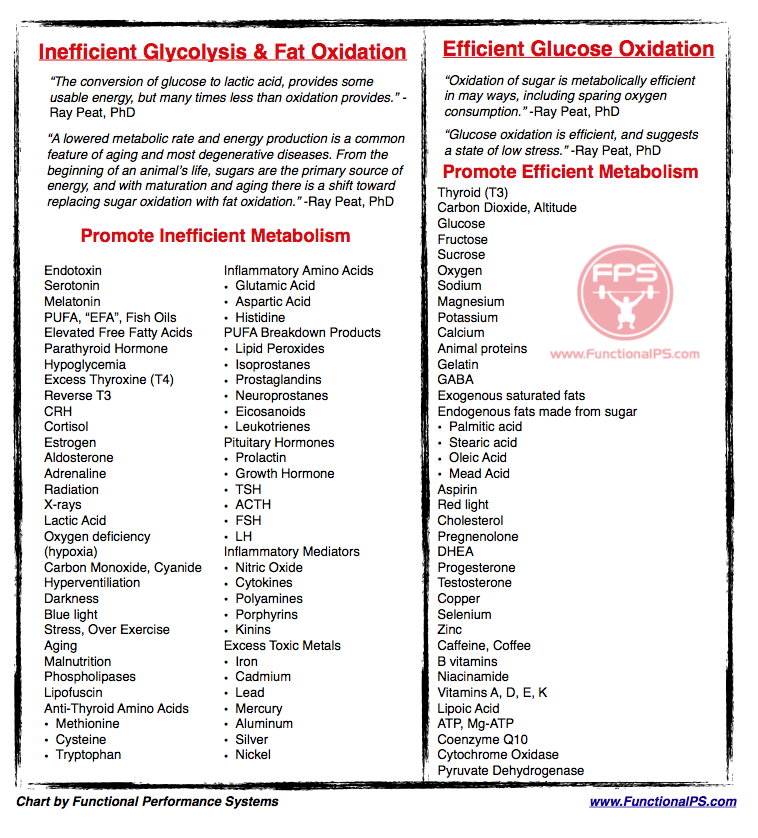
The thumbnail below is a revisable chart that portrays factors that promote efficient or inefficient energy metabolism. The goal of the health conscious should be to maximize the effects of the promoters of efficient metabolism while minimizing the effects of the factors that lead to inefficient metabolism.
Some of the factors that promote inefficient metabolism do serve important functions during stress, but they should be used only intermittently until the stressor subsides. If they have a significant role in physiology relative to the factors that promote efficient metabolism, the human machinery starts to malfunction. Please check with a medical professional about all things related to your health. This chart does not represent medical advice in any way.
Posted in General.
rev="post-5867" 4 comments
– June 18, 2012
Supervision of Resistance Training and Performance
J Strength Cond Res. 2010 Mar;24(3):639-43.
Influence of supervision ratio on muscle adaptations to resistance training in nontrained subjects.
Gentil P, Bottaro M.
The purpose of the present study was to compare the changes in muscle strength in nontrained young males performing resistance training under different supervision ratios. One hundred twenty-four young men were randomly assigned to groups trained under a high (HS, 1:5 coach to athlete ratio) or low (LS, 1:25) supervision ratio. Both groups performed identical resistance training programs. Subjects were tested for maximum bench press 1 repetition maximum (1RM) and knee extensor torque before and after 11 weeks of training. According to the results, only HS lead to a significant increase (11.8%) in knee extensor torque. Both groups significantly increased bench press 1RM load; the increases were 10.22% for LS and 15.9% for HS. The results revealed significant differences between groups for changes in knee extensor torque and 1RM bench press, with higher values for the HS group. There were no differences between groups for the increases in bench press and leg press work volume or training attendance. The proportion of subjects training with maximum intensity was higher in HS for both bench press and leg press exercises. In addition, the distribution of subjects training with maximal intensity was higher for the bench press than for the leg press exercise in both groups. The primary findings of the present study are that the strength gains for both lower- and upper-body muscles are greater in subjects training under higher supervision ratios, and this is probably because of higher exercise intensity. These results confirm the importance of direct supervision during resistance training.
Med Sci Sports Exerc. 2000 Jun;32(6):1175-84.
The influence of direct supervision of resistance training on strength performance.
Mazzetti SA, Kraemer WJ, Volek JS, Duncan ND, Ratamess NA, Gómez AL, Newton RU, Häkkinen K, Fleck SJ.
PURPOSE:
The purpose of this study was to compare changes in maximal strength, power, and muscular endurance after 12 wk of periodized heavy-resistance training directly supervised by a personal trainer (SUP) versus unsupervised training (UNSUP).
METHODS:
Twenty moderately trained men aged 24.6 +/- 1.0 yr (mean +/- SE) were randomly assigned to either the SUP group (N = 10) or the UNSUP group (N = 8). Both groups performed identical linear periodized resistance training programs consisting of preparatory (10-12 repetitions maximum (RM)), hypertrophy (8 to 10-RM), strength (5 to 8-RM), and peaking phases (3 to 6-RM) using free-weight and variable-resistance machine exercises. Subjects were tested for maximal squat and bench press strength (1-RM), squat jump power output, bench press muscular endurance, and body composition at week 0 and after 12 wk of training.
RESULTS:
Mean training loads (kg per set) per week were significantly (P < 0.05) greater in the SUP group than the UNSUP group at weeks 7 through 11 for the squat, and weeks 3 and 7 through 12 for the bench press exercises. The rates of increase (slope) of squat and bench press kg per set were significantly greater in the SUP group. Maximal squat and bench press strength were significantly greater at week 12 in the SUP group. Squat and bench press 1-RM, and mean and peak power output increased significantly after training in both groups. Relative local muscular endurance (80% of 1-RM) was not compromised in either group despite significantly greater loads utilized in bench press muscular endurance testing after training. Body mass, fat mass, and fat-free mass increased significantly after training in the SUP group.
CONCLUSION:
Directly supervised, heavy-resistance training in moderately trained men resulted in a greater rate of training load increase and magnitude which resulted in greater maximal strength gains compared with unsupervised training.
J Strength Cond Res. 2004 May;18(2):316-23.
Effect of direct supervision of a strength coach on measures of muscular strength and power in young rugby league players.
Coutts AJ, Murphy AJ, Dascombe BJ.
The purpose of the present study was to examine the influence of direct supervision on muscular strength, power, and running speed during 12 weeks of resistance training in young rugby league players. Two matched groups of young (16.7 +/- 1.1 years [mean +/- SD]), talented rugby league players completed the same periodized resistance-training program in either a supervised (SUP) (N = 21) or an unsupervised (UNSUP) (N = 21) environment. Measures of 3 repetition maximum (3RM) bench press, 3RM squat, maximal chin-ups, vertical jump, 10- and 20-m sprints, and body mass were completed pretest (week 0), midtest (week 6), and posttest (week 12) training program. Results show that 12 weeks of periodized resistance training resulted in an increased body mass, 3RM bench press, 3RM squat, maximum number of chin-ups, vertical jump height, and 10- and 20-m sprint performance in both groups (p < 0.05). The SUP group completed significantly more training sessions, which were significantly correlated to strength increases for 3RM bench press and squat (p < 0.05). Furthermore, the SUP group significantly increased 3RM squat strength (at 6 and 12 weeks) and 3RM bench press strength (12 weeks) when compared to the UNSUP group (p < 0.05). Finally, the percent increase in the 3RM bench press, 3RM squat, and chin-up(max) was also significantly greater in the SUP group than in the UNSUP group (p < 0.05). These findings show that the direct supervision of resistance training in young athletes results in greater training adherence and increased strength gains than does unsupervised training.
Posted in General.
Comments Off on Supervision of Resistance Training and Performance
– June 17, 2012
PUFA Decrease Cellular Energy Production
Also see:
PUFA – Accumulation & Aging
Free Fatty Acids Suppress Cellular Respiration
PUFA Breakdown Products Depress Mitochondrial Respiration
“Curing” a High Metabolic Rate with Unsaturated Fats
Fat Deficient Animals – Activity of Cytochrome Oxidase
Randle Cycle
Protective “Essential Fatty Acid Deficiency”
Errors in Nutrition: Essential Fatty Acids
ATP Regulates Cell Water
“With aging, cells have less ability to produce energy, and are often more easily stimulated. The accumulation of polyunsaturated fats is one of the factors that reduce the ability of mitochondria to produce energy (Zhang, et al., 2006, 2009; Yazbeck, et al., 1989). Increased estrogen exposure, decreased thyroid hormone, an increased ratio of iron to copper, and lack of light, are other factors that impair the cytochrome oxidase enzyme.” -Ray Peat, PhD
Comp Biochem Physiol A Comp Physiol. 1989;94(2):273-6.
The effects of essential fatty acid deficiency on brown adipose tissue activity in rats maintained at thermal neutrality.
Yazbeck J, Goubern M, Senault C, Chapey MF, Portet R.
1. The consequences of essential fatty acid (EFA) deficiency on the resting metabolism, food efficiency and brown adipose tissue (BAT) thermogenic activity were examined in rats maintained at thermal neutrality (28 C). 2. Weanling male Long-Evans rats were fed a hypolipidic semi-purified diet (control diet: 2% sunflower oil; EFA-deficient diet: 2% hydrogenated coconut oil) for 9 weeks. 3. They were kept at 28 C for the last 5 weeks. Compared to controls, in EFA-deficient rats the growth shortfall reached 21% at killing. 4. As food intake was the same in EFA-deficient and control rats, food efficiency was thus decreased by 40%. 5. Resting metabolism expressed per surface unit was 15% increased. 6. Non-renal water loss was increased by 88%. 7. BAT weight was 28% decreased but total and mitochondrial proteins were not modified. 8. Heat production capacity, tested by GDP binding per BAT was 69% increased in BAT of deficient rats. 9. The stimulation of BAT was established by two other tests: GDP inhibition of mitochondrial O2 consumption and swelling of mitochondria. 10. It is suggested that the observed enhancement of resting metabolism in EFA-deficient rats is, in part, due to an activation of heat production in BAT.
Am J Physiol Cell Physiol. 2006 May;290(5):C1321-33.
Polyunsaturated fatty acids mobilize intracellular Ca2+ in NT2 human teratocarcinoma cells by causing release of Ca2+ from mitochondria.
Zhang BX, Ma X, Zhang W, Yeh CK, Lin A, Luo J, Sprague EA, Swerdlow RH, Katz MS.
In a variety of disorders, overaccumulation of lipid in nonadipose tissues, including the heart, skeletal muscle, kidney, and liver, is associated with deterioration of normal organ function, and is accompanied by excessive plasma and cellular levels of free fatty acids (FA). Increased concentrations of FA may lead to defects in mitochondrial function found in diverse diseases. One of the most important regulators of mitochondrial function is mitochondrial Ca(2+) ([Ca(2+)](m)), which fluctuates in coordination with intracellular Ca(2+) ([Ca(2+)](i)). Polyunsaturated FA (PUFA) have been shown to cause [Ca(2+)](i) mobilization albeit by unknown mechanisms. We have found that PUFA but not monounsaturated or saturated FA cause [Ca(2+)](i) mobilization in NT2 human teratocarcinoma cells. Unlike the [Ca(2+)](i) response to the muscarinic G protein-coupled receptor agonist carbachol, PUFA-mediated [Ca(2+)](i) mobilization in NT2 cells is independent of phospholipase C and inositol-1,4,5-trisphospate (IP(3)) receptor activation, as well as IP(3)-sensitive internal Ca(2+) stores. Furthermore, PUFA-mediated [Ca(2+)](i) mobilization is inhibited by the mitochondria uncoupler carboxyl cyanide m-chlorophenylhydrozone. Direct measurements of [Ca(2+)](m) with X-rhod-1 and (45)Ca(2+) indicate that PUFA induce Ca(2+) efflux from mitochondria. Further studies show that ruthenium red, an inhibitor of the mitochondrial Ca(2+) uniporter, blocks PUFA-induced Ca(2+) efflux from mitochondria, whereas inhibitors of the mitochondrial permeability transition pore cyclosporin A and bongkrekic acid have no effect. Thus PUFA-gated Ca(2+) release from mitochondria, possibly via the Ca(2+) uniporter, appears to be the underlying mechanism for PUFA-induced [Ca(2+)](i) mobilization in NT2 cells.
PLoS ONE 4(6): e6048. doi:10.1371/journal.pone.0006048
Linoleic Acid-Induced Mitochondrial Ca2+ Efflux Causes Peroxynitrite Generation and Protein Nitrotyrosylation
Hong-Mei Zhang1, Howard Dang2, Chih-Ko Yeh3,4, Bin-Xian Zhang1,4*
It is well known that excessive non-esterified fatty acids in diabetes contribute to the pathogenesis of renal complications although the mechanism remains elusive. Enhanced oxidative stress has been hypothesized as a unified factor contributing to diabetic complications and increased protein nitrotyrosylation has been reported in the kidneys of diabetic patients. In the current manuscript we described that linoleic acid (LA) caused mitochondrial Ca2+ efflux and peroxynitrite production, along with increased nitrotyrosine levels of cellular proteins in primary human mesangial cells. The peroxynitrite production by LA was found to depend on mitochondrial Ca2+ efflux. Downregulation of hsp90β1, which has been previously shown to be essential for polyunsaturated fatty acid-induced mitochondrial Ca2+ efflux, significantly diminished LA-responsive mitochondrial Ca2+ efflux and the coupled peroxynitrite generation, implicating a critical role of hsp90β1 in the LA responses. Our results further demonstrated that mitochondrial complexes I and III were directly involved in the LA-induced peroxynitrite generation. Using the well established type 2 diabetic animal model db/db mice, we observed a dramatically enhanced LA responsive mitochondrial Ca2+ efflux and protein nitrotyrosylation in the kidney. Our study thus demonstrates a cause-effect relationship between LA and peroxynitrite or protein nitrotyrosylation and provides a novel mechanism for lipid-induced nephropathy in diabetes.
Endocrine. 2011 Apr;39(2):128-38. Epub 2010 Dec 15.
Long-term exposure of INS-1 rat insulinoma cells to linoleic acid and glucose in vitro affects cell viability and function through mitochondrial-mediated pathways.
Tuo Y, Wang D, Li S, Chen C.
Obesity with excessive levels of circulating free fatty acids (FFAs) is tightly linked to the incidence of type 2 diabetes. Insulin resistance of peripheral tissues and pancreatic β-cell dysfunction are two major pathological changes in diabetes and both are facilitated by excessive levels of FFAs and/or glucose. To gain insight into the mitochondrial-mediated mechanisms by which long-term exposure of INS-1 cells to excess FFAs causes β-cell dysfunction, the effects of the unsaturated FFA linoleic acid (C 18:2, n-6) on rat insulinoma INS-1 β cells was investigated. INS-1 cells were incubated with 0, 50, 250 or 500 μM linoleic acid/0.5% (w/v) BSA for 48 h under culture conditions of normal (11.1 mM) or high (25 mM) glucose in serum-free RPMI-1640 medium. Cell viability, apoptosis, glucose-stimulated insulin secretion, Bcl-2, and Bax gene expression levels, mitochondrial membrane potential and cytochrome c release were examined. Linoleic acid 500 μM significantly suppressed cell viability and induced apoptosis when administered in 11.1 and 25 mM glucose culture medium. Compared with control, linoleic acid 500 μM significantly increased Bax expression in 25 mM glucose culture medium but not in 11.1 mM glucose culture medium. Linoleic acid also dose-dependently reduced mitochondrial membrane potential (ΔΨm) and significantly promoted cytochrome c release from mitochondria in both 11.1 mM glucose and 25 mM glucose culture medium, further reducing glucose-stimulated insulin secretion, which is dependent on normal mitochondrial function. With the increase in glucose levels in culture medium, INS-1 β-cell insulin secretion function was deteriorated further. The results of this study indicate that chronic exposure to linoleic acid-induced β-cell dysfunction and apoptosis, which involved a mitochondrial-mediated signal pathway, and increased glucose levels enhanced linoleic acid-induced β-cell dysfunction.
Posted in General.
Comments Off on PUFA Decrease Cellular Energy Production
– June 15, 2012
Omega -3 “Deficiency” Decreases Serotonin Producing Enzyme
Also see:
Tryptophan Metabolism: Effects of Progesterone, Estrogen, and PUFA
Anti Serotonin, Pro Libido
Gelatin > Whey
Thyroid peroxidase activity is inhibited by amino acids
Whey, Tryptophan, & Serotonin
Tryptophan, Fatigue, Training, and Performance
Carbohydrate Lowers Free Tryptophan
Protective Glycine
Intestinal Serotonin and Bone Loss
Hypothyroidism and Serotonin
Estrogen Increases Serotonin
Gelatin, Glycine, and Metabolism
Whey, Tryptophan, & Serotonin
Tryptophan, Sleep, and Depression
“An excess of tryptophan in the diet, especially with deficiencies of other nutrients, can combine with inflammation to increase serotonin. Polyunsaturated fatty acids promote the absorption of tryptophan by the brain, and its conversion to serotonin. A “deficiency” of polyunsaturated fat decreases the expression of the enzyme that synthesizes serotonin (McNamara, et al., 2009). -Ray Peat, PhD
J Psychiatr Res. 2009 Mar;43(6):656-63. Epub 2008 Nov 4.
Omega-3 fatty acid deficiency during perinatal development increases serotonin turnover in the prefrontal cortex and decreases midbrain tryptophan hydroxylase-2 expression in adult female rats: dissociation from estrogenic effects.
McNamara RK, Able J, Liu Y, Jandacek R, Rider T, Tso P, Lipton JW.
A dysregulation in central serotonin neurotransmission and omega-3 fatty acid deficiency have been implicated in the pathophysiology of major depression. To determine the effects of omega-3 fatty acid deficiency on indices of serotonin neurotransmission in the adult rat brain, female rats were fed diets with or without the omega-3 fatty acid precursor alpha-linolenic acid (ALA) during perinatal (E0-P90), post-weaning (P21-P90), and post-pubescent (P60-130) development. Ovariectomized (OVX) rats and OVX rats with cyclic estrogen treatment were also examined. Serotonin (5-HT) and 5-hydroxyindoleacetic acid (5-HIAA) content, and fatty acid composition were determined in the prefrontal cortex (PFC), and tryptophan hydroxylase-2 (TPH-2), serotonin transporter, and 5-HT(1A) autoreceptor mRNA expression were determined in the midbrain. ALA deficiency during perinatal (-62%, p=0.0001), post-weaning (-34%, p=0.0001), and post-pubertal (-10%, p=0.0001) development resulted in a graded reduction in adult PFC docosahexaenoic acid (DHA, 22:6n-3) composition. Relative to controls, perinatal DHA-deficient rats exhibited significantly lower PFC 5-HT content (-65%, p=0.001), significant greater 5-HIAA content (+15%, p=0.046), and a significant greater 5-HIAA/5-HT ratio (+73%, p=0.001). Conversely, post-weaning DHA-deficient rats exhibited significantly greater PFC 5-HT content (+12%, p=0.03), no change in 5-HIAA content, and a significantly smaller 5-HIAA/5-HT ratio (-9%, p=0.01). Post-pubertal DHA-deficient and OXV rats did not exhibit significant alterations in PFC 5-HT or 5-HIAA content. Only perinatal DHA-deficient rats exhibited a significant reduction in midbrain TPH-2 mRNA expression (-29%, p=0.03). These preclinical data support a causal link between perinatal omega-3 fatty acid deficiency and reduced central serotonin synthesis in adult female rats that is independent of ovarian hormones including estrogen.
Posted in General.
Comments Off on Omega -3 “Deficiency” Decreases Serotonin Producing Enzyme
– June 14, 2012